






Products
BRASS HEXAGONAL INSERT FOR PLASTIC OVERMOLDING (ATSIECM_ATSIECML)
BRASS THREADED INSERTS FOR INSERT MOULDING IN PLASTIC COMPONENTS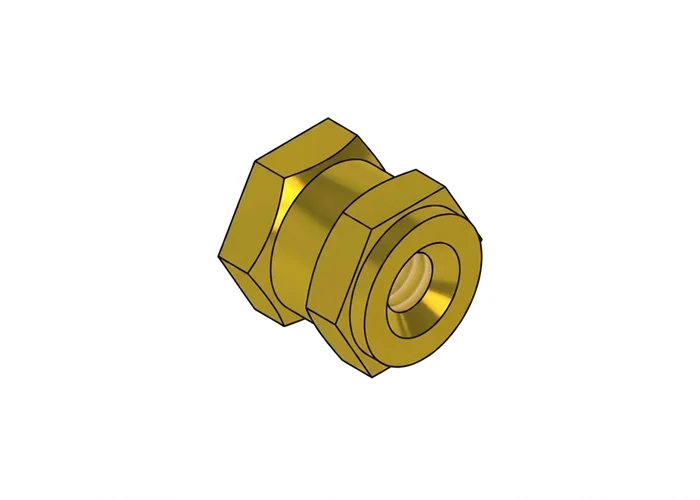
Brass Hexagonal Threaded Insert Plastic Molding
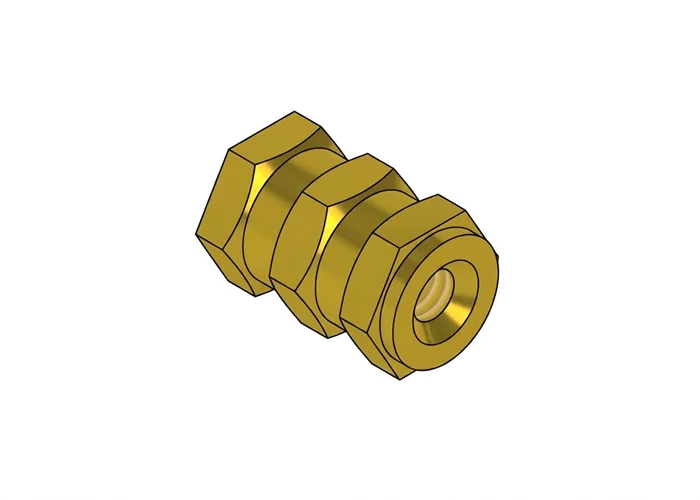
High-strength hexagonal threaded brass bushing for plastic
Threaded brass inserts for injection moulding applications, providing reliable and durable metal threads inside plastic components
Hexagonal brass insert for overmolding is a metal threaded insert used in injection molding processes to create permanent threaded interfaces within plastic components. It is engineered to prevent both rotational movement and pull-out of the insert during mechanical operation, ensuring long-term structural stability of the threaded connection.
In engineering applications, hexagonal inserts are selected when plastic components must withstand high tightening torque, cyclic loads, vibrations, and repeated assembly operations without loss of thread integrity or mechanical loosening.
The hexagonal geometry is a functional design feature rather than a geometric variant. The flat surfaces of the insert create a direct mechanical interlock with the surrounding polymer material, significantly increasing resistance to rotation compared to cylindrical inserts that rely primarily on surface friction.
How does overmolding work with brass hexagonal inserts?
During the overmolding process, the insert is positioned inside the mold cavity and the molten polymer flows around it, fully encapsulating the external geometry. This creates a structurally bonded metal–plastic assembly in which the insert becomes an integral functional element of the final part, eliminating the need for secondary assembly operations.
What is the functional advantage of overmolding?
Overmolding enables the formation of a permanent metal thread directly inside the plastic component, improving load distribution and eliminating thread wear typically associated with plastic-only threaded systems.
This type of insert is suitable for use with engineering thermoplastics and reinforced polymers, including PA6, PA66, PBT, ABS, and PC, which are commonly used in structural and high-performance industrial applications requiring dimensional stability and mechanical resistance.
The functional principle of the hexagonal design lies in transferring part of the mechanical load from the plastic interface to the insert geometry itself. This improves resistance to both rotational failure and axial extraction under load, especially in applications involving dynamic stress conditions.
Hexagonal brass inserts for overmolding are a standard solution for high-reliability threaded connections in injection-molded plastic components.
They are widely used in applications where long-term mechanical performance must be maintained under vibration, thermal cycling, and repeated assembly cycles, ensuring consistency between manufacturing performance and in-field operation.
ATS technical expertise in supply precision inserts for plastics supports industrial applications where dimensional accuracy, repeatability, and mechanical reliability are critical design requirements.
FAQ and insights
Hexagonal threaded inserts for insert molding are brass components designed to be permanently integrated into plastic parts during the injection molding process.
Their hexagonal geometry provides more effective mechanical anchoring, increasing resistance to rotation and pull-out and ensuring a stable and reliable threaded connection.
These inserts are the ideal solution for creating strong and long-lasting fastenings in plastic components subjected to repeated assembly cycles and demanding operating conditions.
Compared to direct plastic threading, hexagonal threaded inserts for insert moulding provide significantly higher mechanical performance and long-term reliability.
The brass structure allows the insert to withstand high tightening torques and repeated assembly cycles without thread degradation, reducing wear, cracking, and loss of fastening strength commonly seen in plastic threads.
This makes them ideal for industrial applications exposed to vibration, dynamic loads, and continuous mechanical stress, where joint stability is critical.
Hexagonal threaded inserts for insert moulding are compatible with the main engineering thermoplastics used in high-performance industrial applications.
These include ABS, PA6, PA66, PBT, PC and PEEK, selected for their mechanical strength, dimensional stability, and suitability for injection moulding processes.
This wide compatibility allows their use across industries such as automotive, industrial electronics, electromechanics, and medical devices, where reliability and long-term performance are essential.
Informative
We and selected third parties use cookies or similar technologies for technical purposes and, with your consent,
also for other purposes as specified in the .
If you close this banner with a tick or click on "Decline", only technical cookies will be used. If you want to select the
cookies to be installed, click on 'Customise'. If you prefer, you can consent to the use of all cookies, including
cookies other than technical cookies, by clicking on "Accept all". You can change your choice at any time.