




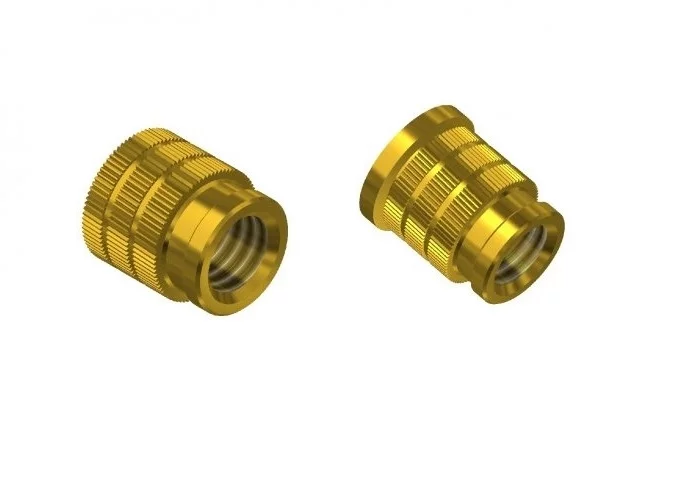
BRASS THREADED INSERTS PRESS-IN INSTALLATION (USP_HSP) |
|
| APPLICATION | BRITTLE THERMOSET MATERIAL |
|---|---|
| ASSEMBLY | BY PRESSURE |


Products
BRASS PRESS-IN THREADED INSERT (USP_HSP)
BRASS PRESS-IN THREADED INSERTS FOR PLASTICSBrass press-in threaded inserts USP (headless) and HSP (with head) are designed to create strong threads in hard and brittle thermosetting materials
Press-in threaded inserts are used to create reliable metal threads inside components made from hard and brittle thermosetting materials. They provide a practical solution when a strong and durable threaded connection is required, without the need for heat installation or ultrasonic insertion methods, helping to maintain the original properties of the material.
Manufactured in brass, these inserts provide a robust internal thread capable of withstanding repeated screw tightening and removal cycles. Compared with a thread formed directly into plastic, a brass threaded insert offers improved mechanical strength, better wear resistance and more consistent fastening performance over the lifetime of the component.
The external design, featuring sharp-edged knurling, improves the mechanical grip between the insert and the plastic material. This structure increases resistance to rotation and torque during assembly, providing a secure connection even in applications where components require frequent maintenance, replacement or repeated assembly operations.
The range includes two different versions designed to meet specific application requirements. The USP version is a headless threaded insert, suitable when a flush installation and reduced overall dimensions are required. The HSP version features an integrated head, providing a larger bearing surface and making it particularly suitable for applications involving thin wall components or where improved load distribution is required.
Press-in inserts for plastics are widely used across industrial sectors including electronics, electrical equipment, automation, industrial machinery and the production of technical components made from thermosetting materials. They are an effective solution wherever a reliable threaded connection, high resistance to rotation and long-term assembly performance are required.
Selecting the correct threaded insert depends on several application factors, including the component geometry, material characteristics, wall thickness, thread size and expected mechanical loads. Choosing the right solution from the beginning helps improve fastening reliability, reduce component damage risks and optimise the overall assembly process.
A.T.S. Lamberti supplies threaded inserts for plastic applications and supports companies, designers and technical departments in identifying the most suitable fastening solution for their requirements. Thanks to its experience in industrial fastening systems, ATS provides technical assistance during insert selection, considering material properties, assembly conditions and required performance.
Choosing the right insert at the design stage can improve the reliability of the final component, simplify assembly operations and extend the service life of the finished product. In addition to supplying the product, ATS provides technical consultancy and application support to help customers identify the most appropriate insert solution for their industrial needs.
Dimensions, available sizes and technical specifications for USP threaded inserts (headless) and HSP threaded inserts (with head) are available in the dedicated product documentation for plastic inserts.
-
+See features
FAQ and insights
A press-in threaded insert is a component made of brass designed to create a strong metal thread inside components made of thermosetting materials.
The insert is installed by pressing it into the component and provides a reliable and durable fastening solution, improving the mechanical strength compared to a thread directly formed in the plastic material.
This type of insert is suitable when working with hard and brittle thermosetting materials and when hot installation or ultrasonic installation systems cannot be used or are not the most convenient solution.
It is also suitable for applications requiring repeated screwing and unscrewing cycles, ensuring reliable fastening and long-lasting performance of the connection.
Both versions are designed for press-in installation, but they feature a different design. The USP insert is headless and is suitable when a fully integrated installation within the component is required, maintaining reduced dimensions and a uniform surface.
The HSP insert, on the other hand, is with head; this feature provides a larger support surface and makes it particularly suitable for components with thin walls, where a better load distribution and improved insert stability are required.
A threaded insert provides a stronger and more durable connection compared to a thread directly formed in the plastic material.
The presence of a metal thread reduces wear on the plastic component, improves resistance to rotation, and allows numerous assembly and disassembly cycles without compromising fastening reliability.
Press-in threaded inserts are used in many industrial sectors, including electronics, electrical engineering, automation, industrial equipment and the production of technical components made from thermosetting materials.
They are an ideal solution for applications where a reliable and strong threaded connection is required, ensuring consistent performance over time and secure component fastening.
The choice of the most suitable threaded insert depends on several factors, including the component material, the wall thickness, the thread dimensions, the expected mechanical stresses and the assembly method.
Proper evaluation of these aspects allows the most suitable solution for the specific application requirements to be identified, ensuring reliable fastening and optimal performance over time.
Informative
We and selected third parties use cookies or similar technologies for technical purposes and, with your consent,
also for other purposes as specified in the .
If you close this banner with a tick or click on "Decline", only technical cookies will be used. If you want to select the
cookies to be installed, click on 'Customise'. If you prefer, you can consent to the use of all cookies, including
cookies other than technical cookies, by clicking on "Accept all". You can change your choice at any time.