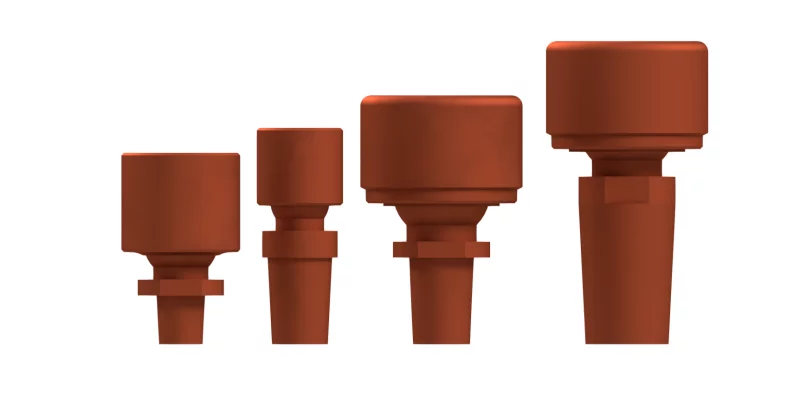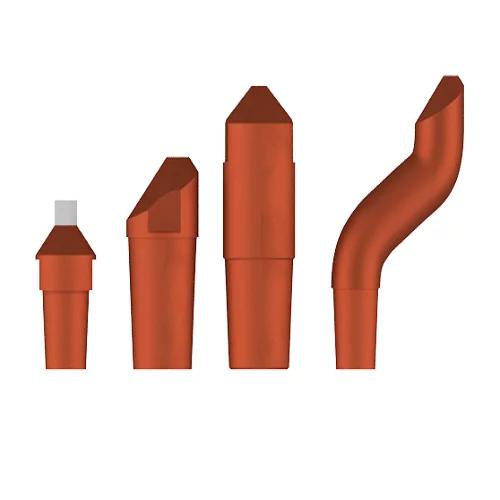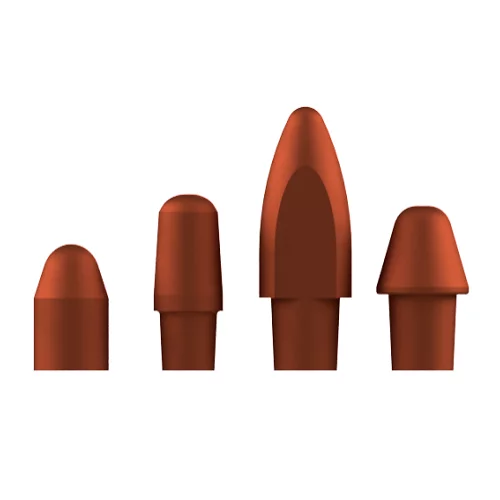






When the surfaces to be joined are not perfectly regular, maintaining consistent electrode contact can be challenging during resistance spot welding. Ball-type copper alloy welding electrodes provide a degree of self-alignment that allows the electrode to adapt to uneven or irregular flat surfaces, helping to maintain more consistent contact and supporting a cleaner appearance of the finished weld spot.
A.T.S. supplies both standard fully water-cooled ball electrodes and articulated ball electrodes with partial cooling. The two configurations are suited to different operating requirements and can be selected according to the welding cycle, component geometry and cooling conditions. The articulated design is particularly useful where the electrode needs to accommodate small variations in the surface angle during contact with the workpiece.
The cooling arrangement is an important distinction between the available configurations. In a fully cooled version, a dedicated seal closes the upper section of the electrode, allowing the cooling water to circulate through the articulated joint and reach the upper part of the electrode. This improves heat management around the working area and can contribute to a better visual finish of the weld spot compared with a partially cooled articulated electrode, particularly in applications where thermal stability is important.
The ability of the ball joint to accommodate surface irregularities makes these electrodes suitable for resistance spot welding applications where a conventional fixed contact geometry may be less effective. The self-aligning movement helps the electrode follow the workpiece surface, supporting more consistent contact conditions during the welding cycle and making the solution particularly useful where weld appearance is an important consideration.
A.T.S. supplies ball-type electrodes and provides technical support when selecting the appropriate configuration. The choice can take into account the workpiece geometry, surface condition, welding parameters, duty cycle and cooling requirements, allowing the electrode to be matched more closely to the resistance welding equipment and the specific production application.