





Disks and rolls for continuous weldings
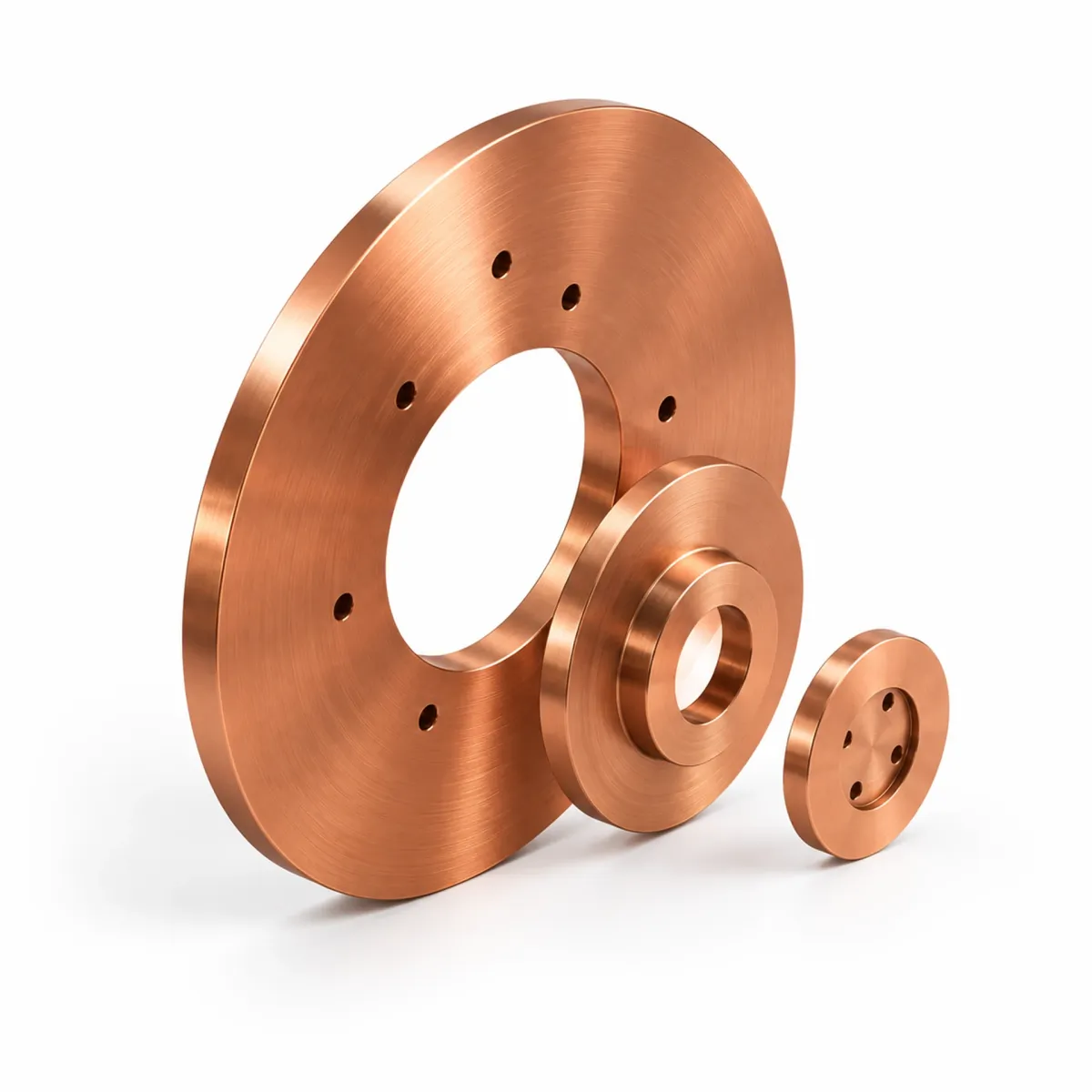
Disks and rolls in copper for continuous weldings
Copper alloy welding wheels and rollers are used in resistance seam welding applications where a continuous, reliable joint is required, particularly when the finished component needs a high level of resistance to air or water leakage. A.T.S. supplies standard wheels and rollers as well as customised solutions manufactured according to the customer's technical requirements and the configuration of the welding equipment.
During seam welding, the rotating rollers apply mechanical pressure and welding current to the sheets while moving along the joint. This produces a series of closely spaced weld nuggets which overlap one another, creating a continuous welded seam rather than a series of isolated spot welds. The overlapping welds help close the joint and provide the level of leak tightness required for specific industrial applications.
Resistance seam welding is particularly suitable for thin sheet metal and components where a continuous connection is more important than individual spot welds. Compared with conventional resistance spot welding, the use of welding wheels allows the joint to be formed continuously along the required welding path, making the process suitable for applications where mechanical strength and controlled air or water tightness are important requirements.
The correct wheel or roller configuration depends on the material and thickness of the sheets, the welding current, the component geometry and the operating conditions of the machine. Wheel diameter, profile, copper alloy and configuration can therefore be selected according to the specific welding process and the characteristics of the equipment.
A.T.S. supplies copper alloy welding wheels and rollers for resistance seam welding, available in standard configurations or according to customer specifications. Technical support is available to help identify the appropriate solution based on the welding system, material, sheet thickness, joint geometry and required sealing performance.
The right solution for your application, with the support of our experts
Our experts will help you find the right product for your needs, with no obligation. Tell us what you need: together we will find the most suitable solution.
Contact us, no obligation