





Robot guns for resistance welding
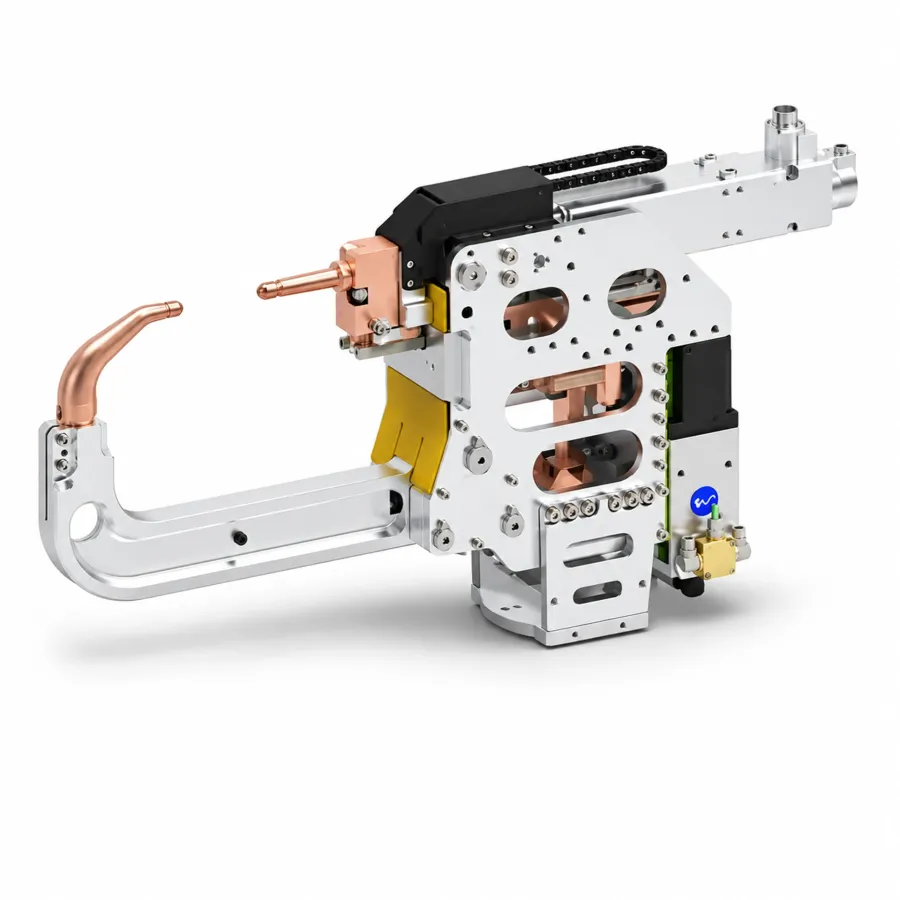
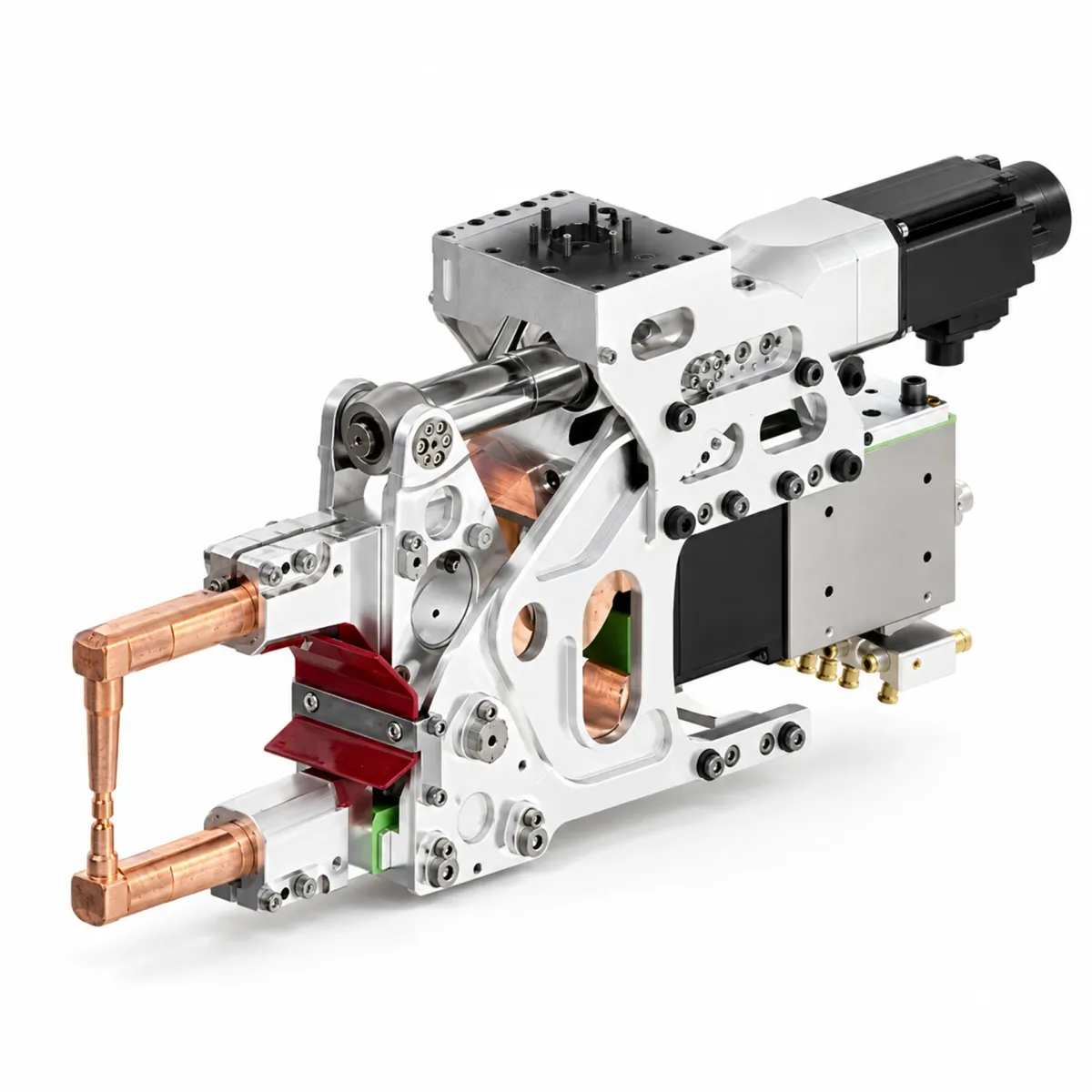
TECNA servo-driven and pneumatic resistance welding guns in X-type and C-type configurations for industrial robots and automated welding cells
A.T.S. supplies TECNA robotic resistance spot welding guns for automated sheet metal joining, industrial robot cells and production lines. The range covers servo-driven and pneumatic equipment, with X-type and C-type mechanical arrangements and different transformer, electrode force and arm configurations.
In robotic resistance welding, an industrial robot positions the gun at programmed welding locations. The electrodes clamp the components and conduct the welding current through the joint. Heat is generated by the electrical resistance of the materials and contact interfaces, producing a weld nugget when the applied current, welding time and electrode force are appropriate.
Servo-driven robotic spot welding guns
TECNA servo-driven robotic welding guns use servo actuation to manage electrode movement as part of the robotic welding sequence.
Depending on the actuator and robot interface, the approach, closing and opening movements can be programmed to match the component geometry and production cycle. Controlled electrode approach can help reduce mechanical impacts when the electrodes contact the sheet metal.
TECNA offers Light, Standard and Heavy configurations, with different arm geometries and available electrode forces. The 2933 Light, currently listed by A.T.S., is an X-type robotic welding gun with 52 or 82 kVA MFDC transformer options and a maximum electrode force of 600 daN.
Servo actuation provides control over mechanical movement, but suitable welding current, force and time settings are still required to form a consistent joint.
Pneumatic robotic welding guns
Pneumatic robot spot welding guns use compressed-air cylinders to operate the electrodes. TECNA offers X-type models, including the 2900, 2901, 2911 and 2920, alongside C-type arrangements such as the 2915.
The available configurations differ in actuator size, electrode force, welding arms and transformer specifications.
Pneumatic actuation can be integrated into repetitive robotic welding cycles, provided the compressed-air supply and control system are suitable. The actual electrode force must be assessed against the selected cylinder and operating pressure, rather than inferred from nominal machine capacity alone.
X-type and C-type welding gun geometry
An X-type welding gun has a pivoting arm arrangement. As the gun closes, the moving electrode follows an angular path. This movement must be considered when welding near flanges, reinforcements or restricted areas.
With a C-type welding gun, the moving electrode generally travels along a linear axis towards the opposing electrode. The arrangement may provide more convenient access for certain part geometries.
Neither design is inherently better for every application. Available clearance, fixture design, required electrode force and robot movements determine the suitable configuration.
Suspended or portable spot welding guns may also be appropriate for assisted and semi-automated workstations, but these are not equivalent to robot-mounted guns and require a separate assessment of their intended operation.
Power supply, cooling and robot compatibility
TECNA robotic welding guns include different electrical arrangements, depending on the model. MFDC welding systems use medium-frequency inverter technology and secondary rectification to supply direct current to the electrodes.
The welding circuit must deliver the required current while taking account of transformer characteristics, secondary impedance and the operating duty cycle.
Cooling performance is equally important. Repeated welds heat the electrodes and current-carrying components, so water flow, temperature and circuit condition must remain within the equipment requirements.
Robot integration also requires assessment of gun weight, centre of gravity, moment of inertia, mounting interfaces and the space occupied during movement. Robot payload ratings alone do not establish compatibility.
Technical selection and A.T.S. support
Choosing a robotic welding gun involves reviewing the sheet material, thickness, weld positions, production cycle and required electrode force. The actuator, transformer, arm geometry and cooling system must then be matched to the robot and welding cell.
A.T.S. supplies TECNA robotic welding guns and provides technical guidance for equipment selection, helping manufacturers and system integrators assess mechanical and electrical compatibility before installation. Properly specified equipment supports repeatable welding conditions and reduces avoidable integration difficulties.
The right solution for your application, with the support of our experts
Our experts will help you find the right product for your needs, with no obligation. Tell us what you need: together we will find the most suitable solution.
Contact us, no obligation