





Servo-Driven Robotic Spot Welding Guns
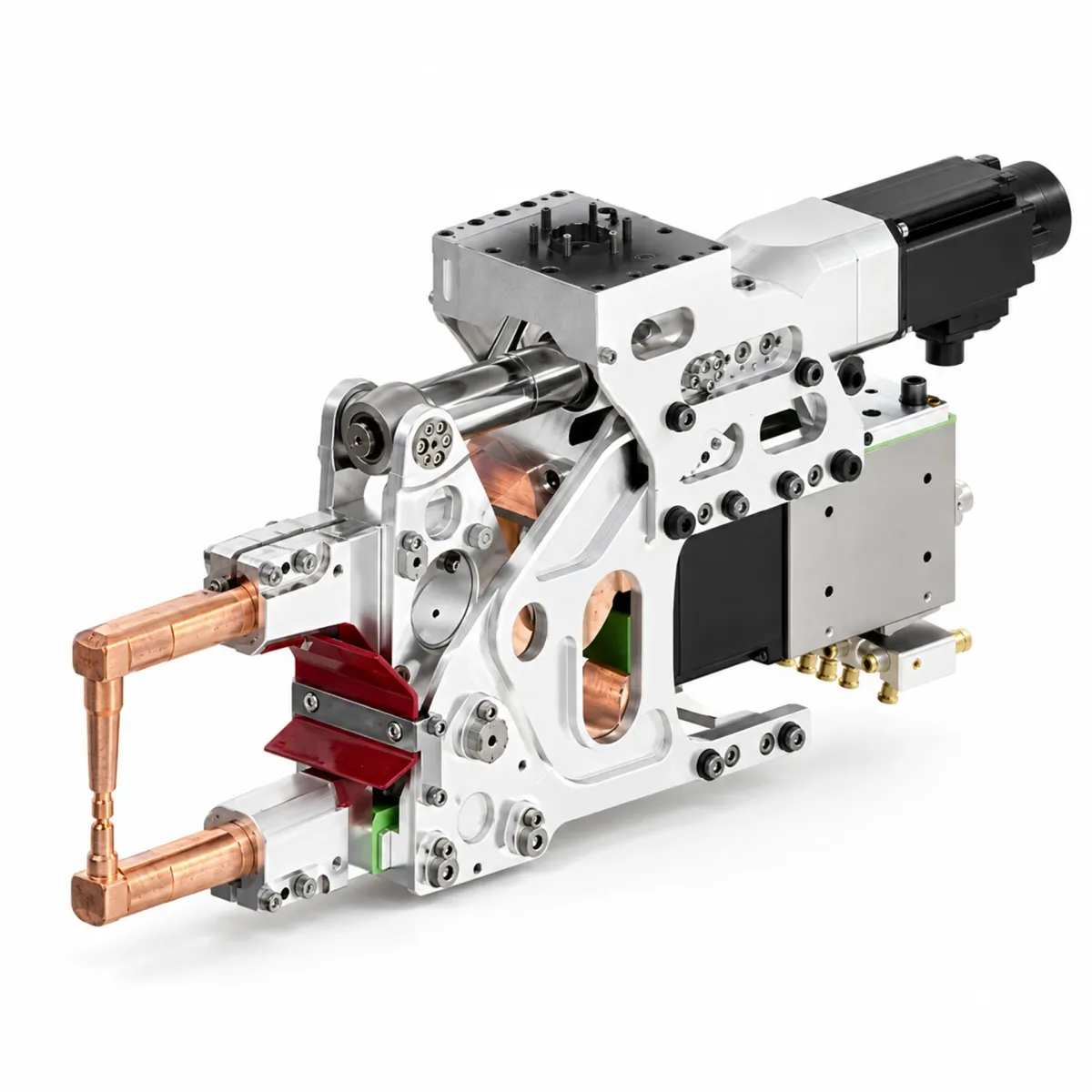
Servo-driven robotic resistance spot welding guns, available in X-type and C-type configurations for automated industrial production lines.
TECNA servo-driven robotic spot welding guns are used in automated manufacturing lines to join overlapping metal sheets and components by resistance spot welding. Mounted on an industrial robot, the gun positions its electrodes at programmed welding locations, applies the required clamping force and works with the welding controller to complete each weld. Servo actuation allows the electrode movement to be managed through the robot control system, providing greater flexibility over approach, closing and opening movements than conventional pneumatic actuation.
The TECNA range includes X-type and C-type robotic welding guns, with Light, Standard and Heavy versions covering different mechanical layouts, electrode forces and installation requirements. Selecting the right gun involves more than choosing a nominal welding capacity. The part geometry, robot payload, required weld force, electrode accessibility and space available inside the robotic cell all influence the final configuration.
Several models use TECNA's universal motorless actuator, designed to operate with a servomotor supplied by the robot manufacturer. Rather than relying on a separate pneumatic actuator, the gun movement can be incorporated into the robot's servo-controlled motion system, subject to the appropriate mechanical interface and control compatibility. Other actuator arrangements are available on certain models, making it necessary to check the exact drive configuration before specifying the equipment.
Resistance spot welding works by passing electrical current through the metal sheets while they are compressed between two electrodes. The electrical resistance of the materials and their contact interfaces generates heat, producing a weld nugget at the joint. The result depends on the relationship between welding current, weld time and electrode force, as well as material thickness, surface condition, electrical conductivity and electrode geometry. A servo-driven gun provides controlled mechanical movement, but it does not replace the need to establish suitable welding parameters.
A major consideration in robotic spot welding is how the electrodes approach the workpiece. Excessive closing speed or incorrect positioning can cause mechanical impacts, unwanted deformation or inconsistent contact conditions. With servo actuation, the movement profile can be programmed to suit the welding sequence, allowing the electrodes to approach the sheet metal in a controlled manner before the required force is applied. Where properly integrated, this can reduce mechanical stress and help maintain more consistent operating conditions over repeated production cycles.
X-type robotic spot welding guns use a pivoting arm arrangement. Their geometry can be useful when the welding point requires a particular opening movement or when access conditions favour articulated electrodes. C-type robotic spot welding guns have a different mechanical arrangement, generally with a moving electrode travelling along a linear axis towards the opposing electrode. Neither design is universally preferable: the position of the weld, component flanges, reinforcing sections and available clearance determine which configuration is more suitable.
TECNA's Light series includes the 2933 and 2934, developed for applications where gun weight and overall dimensions are significant selection factors. The 2943 and 2944 Standard versions provide alternative mechanical configurations and welding force capabilities. The 2946 and 2947 C-type models extend the range for applications requiring this electrode arrangement, while the 2954 and 2955 Heavy X-type models address more demanding mechanical requirements. The 2954 is also identified in the TECNA range as an aluminium version.
Gun weight must be assessed together with the robot's actual operating capacity. The rated payload alone is insufficient to establish compatibility, because the centre of gravity, mass distribution, moment of inertia and mounting position also affect robot performance. A long-arm welding gun may impose different dynamic loads from a compact design, even when their total weights are comparable. Cable routing, cooling connections and the gun's swept volume must also be considered to avoid interference with fixtures or nearby equipment.
Depending on the model, TECNA robotic guns can be configured with different welding arms, electrode arrangements and transformer options. Arm geometry affects access to the joint and influences the mechanical behaviour of the gun under load. The electrical configuration must provide the current required by the welding process while accounting for transformer characteristics, secondary circuit impedance and operating duty. MFDC configurations, where specified, use medium-frequency inverter technology to supply the welding circuit with direct current.
Cooling is another aspect that directly affects welding performance. Repeated welds generate heat in the electrodes and secondary current path, making an adequate cooling circuit necessary for stable operation. Water flow, inlet temperature and water quality must be compatible with the equipment requirements. Poor cooling can accelerate electrode wear and alter contact conditions, with consequences for weld consistency and maintenance intervals.
These servo-driven welding guns are used in automotive body assembly, industrial sheet metal fabrication and robotic manufacturing of welded metal structures. They are particularly relevant where multiple spot welds must be performed at programmed locations and where the welding sequence forms part of an automated production cycle. Actual suitability depends on the materials, joint design, accessibility and process specifications rather than the industrial sector alone.
A.T.S. supplies TECNA servo-driven robotic spot welding guns and provides technical advice to help manufacturers select equipment for their production requirements. The assessment covers robot compatibility, required electrode force, gun geometry, transformer configuration and the characteristics of the components being joined. By evaluating these factors before installation, manufacturers can select a suitable robotic welding gun without introducing unnecessary weight, mechanical restrictions or avoidable integration problems into the production cell.
The right solution for your application, with the support of our experts
Our experts will help you find the right product for your needs, with no obligation. Tell us what you need: together we will find the most suitable solution.
Contact us, no obligation