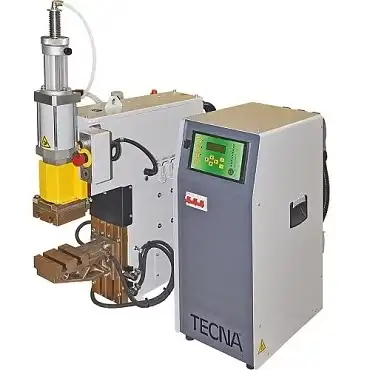





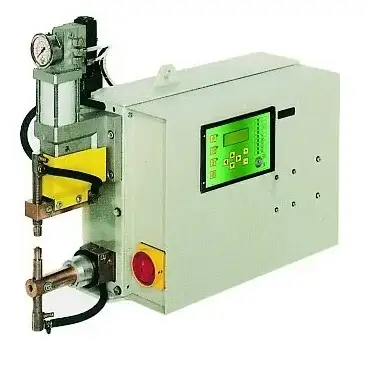
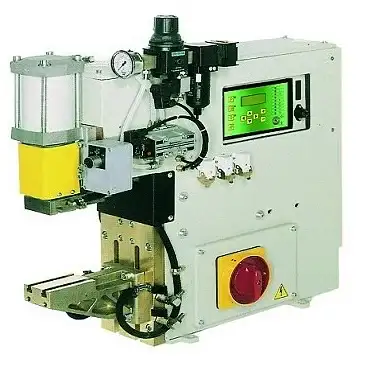
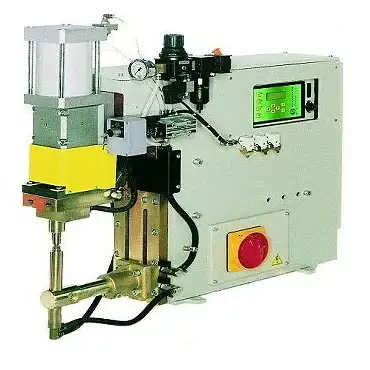
Bench spot and projection welders (2101D-2144D e 2102N)
Foot-operated resistance welders (16kVA-150kVA)
The spot and projection bench resistance welders (2101D-2144D and 2102N) are designed to offer high performance and operational flexibility across a wide range of industrial applications. The nominal power at 50% in direct current ranges from 16kVA to 150kVA, making them suitable for both light-duty work on small components and more robust assemblies.
All machines, except for the model (2101N), are equipped with a microprocessor control with direct reading of the welding current, a key feature to ensure reliability, repeatability, and process control. The cylinder and rod are made of thick chrome-plated steel, a construction choice ideal for heavy-duty environments requiring long service life and mechanical resistance. The adjustable anti-rotation device ensures precision and stability during every welding cycle.
Another strength of these machines is the use of pneumatic components that do not require lubrication, thus eliminating the emission of oil mist and helping to maintain a cleaner and safer working environment. Models (2121D-2144D) are equipped with a double-stroke cylinder and key switch control, allowing advanced adjustment of welding parameters.
Each machine includes a built-in compressed air filter-regulator unit and a shut-off valve for air supply, ensuring continuity and efficiency in airflow management. The two-stage electric foot pedal allows the piece to be clamped and the welding process to start only when conditions are optimal, improving weld quality and reducing the risk of errors. There is also provision for connecting a second two-stage electric foot pedal, with direct recall of welding program no. 2, except for models (2101D-2102N-2103D) and versions equipped with options (2161) and (2181).
The welding transformer, plates, electrode holders, and copper alloy electrodes are water-cooled, while the windings are resin-encapsulated for added protection and greater long-term reliability. The synchronous control with SCR is isolated from the cooling circuit and protected by a thermostat, ensuring safe operation even in the most demanding conditions.
All models, except for (2102N), are equipped as standard with a two-hand control with safety timer and removable key selector to prevent accidental or unauthorized activation. The dual-control is standard in projection welding versions and available upon request for spot welders. Models (2101D-2103D-2144D) are prepared for dual-control connection, thus offering additional options for customizing the work cycle.
Frequently asked questions
Electrical resistance welding is a process of joining metals using heat generated by the electrical resistance of the material itself. The parts to be joined are placed in contact with each other and passed through by an electric current. The passage of current generates heat that melts the metal in the contact zone, thus creating a permanent joint.
Electrical resistance welding offers several advantages over other welding methods, including:
-
High joint strength and reliability
-
High production speed
-
Low heat input
-
Clean and slag-free process
- Possibility of welding different metals
Electric resistance welding is used in a wide range of industrial applications, including:
-
Auto Body
-
Household appliances
-
Metal construction
-
Railway industry
-
Electronics manufacturing
Tecna bench spot and projection welders are robust and reliable welders designed for electric resistance welding of sheet metal. They have the following features:
-
Rated power at 50% continuous current from 16kVA to 150kVA
-
Microprocessor control with direct reading of welding current
-
Heavy-duty, long-life chrome-plated steel cylinder and rod
-
Pneumatic components requiring no lubrication
-
Key-operated double stroke cylinder
-
Regular compressed air filter unit included in the machine
-
Two-stage electric foot pedal
-
Welding transformer, plates, electrode holder and water-cooled copper alloy electrodes
-
Synchronous control with water-cooled SCR and protection thermostat
-
Two-hand control with timer for maximum safety
Request information about this product
Leave us your details: we will get back to you as soon as possible with all the information about this product.
Products in the same category
Spot and projection bench spot welding machines