





Self-tapping installation
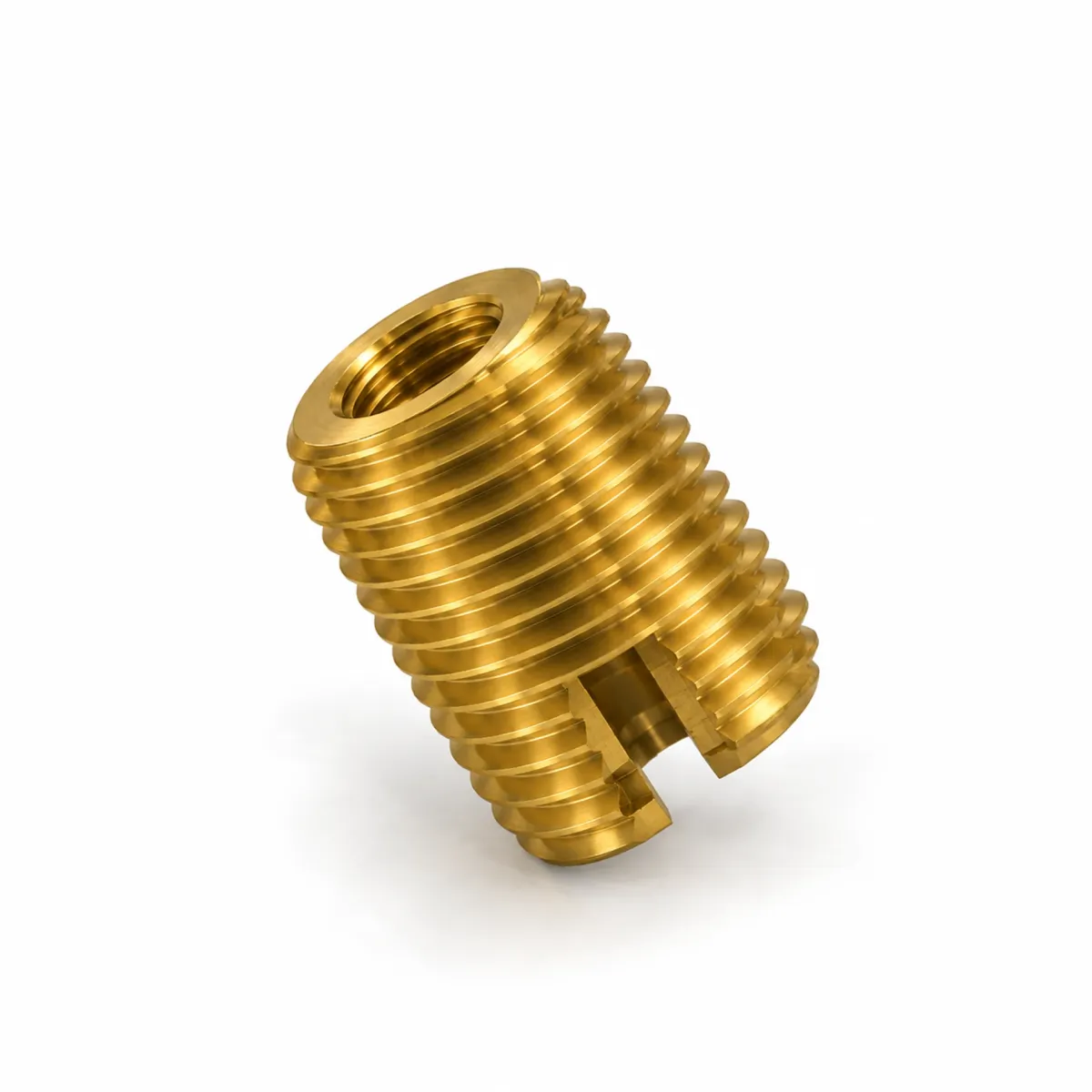
Self-tapping brass threaded inserts for thermoplastics and thermosets, creating metal threads in pre-drilled holes without prior tapping
Self-tapping threaded inserts for plastics provide a metal internal thread in moulded or machined plastic components without requiring the installation hole to be tapped beforehand. The insert has an external thread that cuts into the surrounding material as it is screwed into position, creating a mechanical fixing point for a metric assembly screw.
A.T.S. supplies the U212 self-tapping brass insert, featuring internal and external threads and a cutting slot. It is intended for suitable thermoplastic and thermosetting materials and can be installed using manual or machine-operated tools.
This type of fastening is particularly relevant where a thread formed directly in the plastic may be vulnerable to wear or insufficient engagement during repeated assembly operations.
How self-tapping inserts work
Unlike a screw driven directly into plastic, a self-tapping insert remains in the component and provides a separate metal thread for the assembly fastener.
During installation, the U212 is rotated into a prepared hole. Its cutting feature allows the external thread to create its own engagement with the plastic material.
The resulting fixing must withstand both the forces transmitted through the assembly screw and any tendency of the insert to turn or pull out of its housing.
Actual performance depends on the plastic grade, insert geometry, hole preparation and dimensions of the surrounding material. A brass insert does not automatically guarantee a particular pull-out resistance or tightening torque.
Hole preparation and installation requirements
The pilot hole diameter is one of the main factors affecting installation. If the hole is undersized, the insertion torque can become excessive and generate damaging stresses in the surrounding plastic. If it is oversized, the external thread may not engage enough material to provide the required retention.
Hole depth must also be considered, particularly for blind holes. Sufficient clearance is needed to accommodate the complete insert without forcing it against the bottom of the hole.
The component design should provide adequate wall thickness and distance from edges. On moulded bosses, these dimensions influence the risk of cracking during insertion and the mechanical resistance of the final fixing.
The U212 can be installed into blind or through holes, with manual tools or a suitable tapping machine. Tool alignment and controlled installation are important to avoid damaging the insert or its housing.
Choosing between self-tapping and other plastic inserts
Self-tapping inserts are fitted by rotation and create their own engagement in the plastic.
Heat-installed inserts use controlled heating to allow softened thermoplastic material to flow around the insert's retaining geometry. Press-fit inserts, by contrast, rely on axial installation force and mechanical retention.
These methods place different requirements on component geometry and material behaviour. Their suitability should be assessed against the plastic type, assembly loading and available manufacturing process.
Applications and technical assistance
Self-tapping brass inserts can be used for threaded fixing points in plastic housings, mechanical components, electrical equipment and moulded industrial assemblies.
The U212 self-tapping brass bush is available through A.T.S. for suitable thermoplastic and thermosetting applications.
A.T.S. provides technical guidance on selecting self-tapping inserts, helping manufacturers evaluate the plastic material, prepared hole, component dimensions and installation method. Correctly matching the insert to its housing helps limit assembly damage and supports consistent thread engagement.
The right solution for your application, with the support of our experts
Our experts will help you find the right product for your needs, with no obligation. Tell us what you need: together we will find the most suitable solution.
Contact us, no obligation