10 articles available

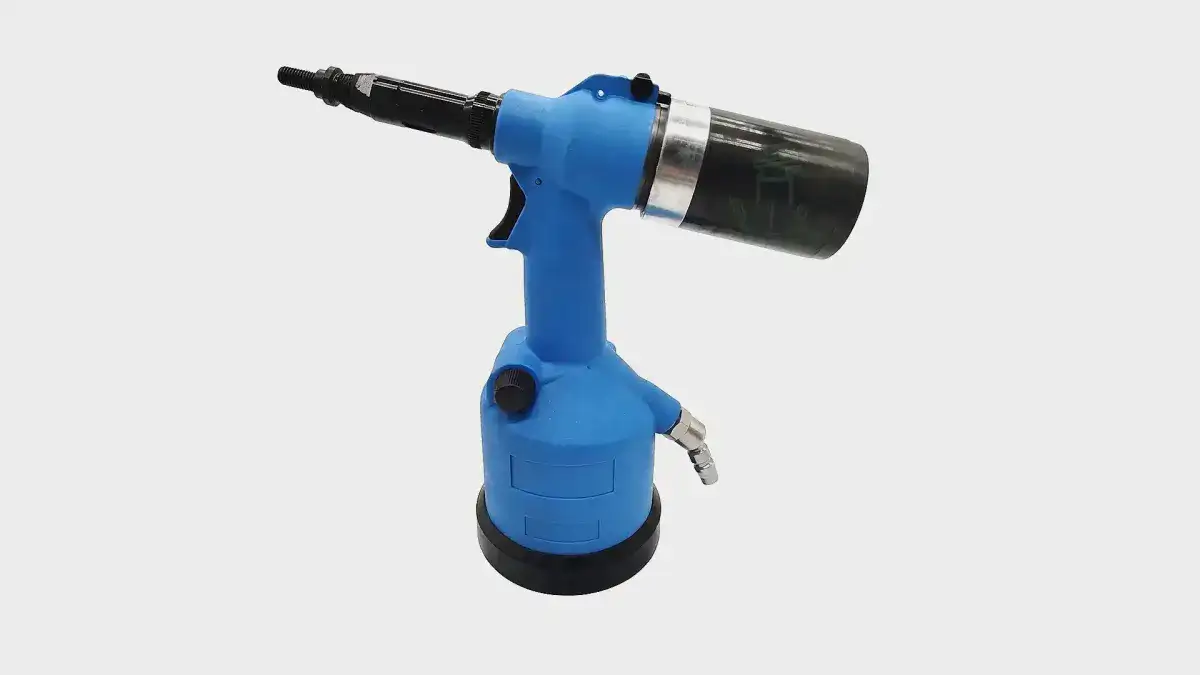
Riveting tool for blind rivet nuts The riveting tool for blind rivet nuts is an essential tool in the field of fastening systems, providing a practical and efficient solution for applications requiring strong and durable joints. A.T.S. Lamberti, a leading supplier of equipment and materials for welding and fastening systems, offers a range of high quality riveting machines for threaded inserts, designed to meet the needs of professionals.What is a riveting tool for blind rivet nuts?   The riveting tool for blind rivet nuts is a tool used to install blind rivet nuts into various materials, such as steel, aluminium, plastic and composites. These blind rivets nuts, also known as threaded rivets or threaded bushings, make it possible to create internal threads in components that otherwise could not support screws or bolts due to their reduced thickness or the nature of the material.How it works: The riveting tool for blind rivet nuts applies a tensile force to the blind rivet nuts, which deforms and expands, locking firmly into the base material. This process not only creates a strong internal thread, but also improves the load distribution on the surface of the material, preventing damage and increasing the strength of the joint.Types of blind rivet nuts: Blind rivet nuts are available in different configurations, such as cylinder head, countersunk and reduced head blind rivet nuts, each designed for specific applications. Common materials for blind rivet nuts include stainless steel, carbon steel and aluminium, each with distinctive properties to withstand different operating environments and mechanical stresses.Advantages of using riveting tool for blind rivet nuts   Versatile use: Riveting tool for blind rivet nuts can be used on a wide range of materials, including those with thin thicknesses or difficult-to-machine properties, such as high-strength steel or composites. This makes them ideal for applications in industries such as aerospace, automotive, electronics and construction.Assembly accuracy: Blind rivet nuts offer high precision in creating internal threads, ensuring the correct alignment of components and improving assembly quality. This is especially crucial in applications where precision tolerances are critical, such as in the production of electronic devices.Operational efficiency: Riveting tool for blind rivet nuts allow fast and effortless installation of blind rivet nuts, reducing production time and minimising downtime. Pneumatic and electric models, in particular, offer higher installation speed than manual models, making them suitable for high-intensity production lines.Joint reliability: Blind rivet nuts provide a durable solution for threaded connections, preventing common problems associated with traditional welding, such as thermal deformation and cracking. In addition, the ability to replace rivet nuts in the event of wear or damage extends the life of components.Strength and durability: Joints created with blind rivet nuts are highly resistant to mechanical stress, vibration and adverse environmental conditions. This ensures greater reliability of the assembled structures and reduces the need for maintenance or replacement.Industrial applications   The riveting tool for blind rivet nuts are used in a variety of industries due to their versatility and reliability. Some of the most common applications include:Automotive: Used to fasten interior and exterior components such as body panels, seats and mouldings. Blind rivet nuts allow quick and precise installation, improving assembly line efficiency and joint quality.Electronics: They offer precise solutions for electronic component and equipment assemblies. Blind rivet nuts allow the creation of secure connections in confined spaces and delicate materials, reducing the risk of damage during the assembly process.Construction: Used for the assembly of metal structures and prefabricated panels. Blind rivet nuts allow for strong and durable connections, essential for the stability and safety of building structures.Theriveting tool for blind rivet nuts is an advanced and reliable solution for those working in the welding and assembly industry.A.T.S. Lamberti is committed to providing high quality tools that meet the needs of professionals, guaranteeing innovative and durable products.  For more information on our products and to discover our complete range of riveting machines for blind rivet nuts, please visit our website or contact our team of experts. Industrial equipment
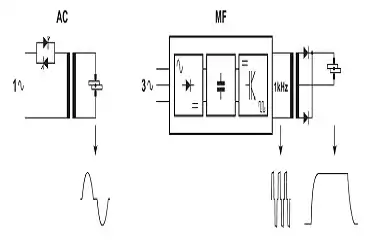
ADVANTAGES PROVIDED BY MEDIUM FREQUENCY WELDING Direct current medium frequency welding   Ordinary welders use a single-phase welding transformer that supplies alternate welding current; the welding current is adjusted by the thyristors by means of the phase-shift technique. This new technology employs an inverter supplies by the three-phase mains. Inside the inverter the current is rectified, filtered by the capacitors and transformed by an IGBT bridge into alternate current at medium frequency (1000Hz). It is used a specific welding transformer equipped with a rectifier that supplies direct welding current.  Advantages provided by medium frequency welding   Current is affected neither by the dimensions of the secondary circuit nor by the ferrous material inside the secondary circuit itself nor by the heating of the welding machine nor by the variations of the mains voltage. The welding current is supplied continuously and constantly. The fusion area heats up in a more homogeneous way improving the quality obtained. Costant an accurate welding current. The adjustment in millisec. allows the best welding time set-up. Welding time reduction that allows an increase in productivity. Reduction of the used welding current. The electrodes lifetime is longer and a less required maintenance allows a better productivity. This effect is particularly emphasised on aluminium and galvanized sheets spot welding. Improved weldability of unlike and highly conductive materials. Aesthetically improved results due to a minor deformation of the piece to be welded and to a reduced electrode indentation. Reduced possibility that melted material spatters during the welding process. High speed of welding current rise. Allows to weld the materials more easily and to solve problems of difficult welding. Reduced electric consumption. Reduced current absorption, balanced on the three phases. Reduced installation costs and improved power factor (cos φ). Therefore, the inverter technology involves a remarkable improvement of the welding quality, an extreme precision of the welding time and current, a higher productivity and reduction in costs.As a result, inverter technology offers many advantages: a higher welding quality, an extreme precision in time and current, improved productivity and reduction in costs. Resistance spot welding