






Products
TECNA TE710 Welding Control Unit for MFDC Spot Welding Systems
CONTROL UNIT FOR RESISTANCE WELDING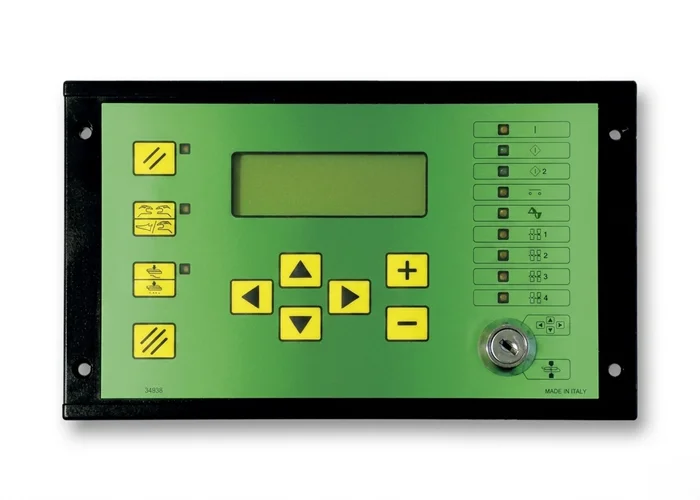
Advanced electronic control for TECNA suspended spot welding guns with precise management of welding parameters, repeatable results and optimized industrial production processes.
Reliable resistance spot welding starts with precise process control. In industrial production, achieving consistent weld quality requires more than a powerful welding system: it requires accurate management of current, energy, timing and process variations throughout every welding cycle. The TECNA TE710 welding control unit has been developed to provide advanced control of suspended medium-frequency spot welding systems, helping manufacturers improve repeatability, efficiency and production stability.
Designed for use with TECNA suspended welding guns equipped with inverter technology, the TE710 electronic welding controller allows operators to manage welding parameters with a high level of precision. By adapting the process to different materials, thicknesses and production requirements, the system helps achieve consistent spot welds while reducing quality variations and unnecessary adjustments.
In demanding industrial applications, welding performance can be affected by several factors, including material resistance changes, component geometry and production conditions. The TECNA TE710 addresses these challenges by providing multiple regulation strategies that allow manufacturers to select the most suitable control method for each application.
The controller features six operating modes: FIX, constant current, constant power, constant voltage, constant energy and DYNAMIC mode. These functions allow the welding process to be optimized according to the characteristics of the component and the level of control required by the production environment.
Constant current regulation helps maintain stable welding conditions despite variations in electrical resistance, while constant power, voltage and energy modes provide additional control over heat input. The DYNAMIC function offers advanced process management for applications where welding conditions may vary during production.
One of the main advantages of the TECNA TE710 control unit is its ability to manage complex production requirements through extensive program storage. The system can store up to 300 welding programs, each with an alphanumeric identification, allowing operators to quickly select the correct parameters for different components and manufacturing processes.
Each welding program includes multiple adjustable parameters defining the complete cycle. Beyond the standard four-stage welding sequence, the TE710 supports advanced functions such as pre-welding current, post-welding current, current slope control, pulse welding and precise time adjustment with 1 millisecond resolution.
This advanced flexibility is particularly valuable for manufacturers producing different assemblies or working with materials requiring specific welding conditions. Precise parameter management helps improve production consistency, reduce rejects and maintain stable weld quality over long manufacturing cycles.
The TECNA TE710 controls medium-frequency IGBT inverter systems and allows selection of inverter operating frequencies between 1000 Hz and 4000 Hz. This technology provides accurate energy delivery during the welding cycle, improving process control compared with traditional welding regulation systems.
During operation, the controller provides detailed information about welding performance, including RMS welding current, energy, power, electrode voltage, initial and final material resistance and machine thermal utilization. These measurements support production monitoring and help manufacturers evaluate process stability.
For applications requiring strict quality assurance, the system allows control limits to be set for welding current, electrode voltage, energy, power, inverter utilization and material resistance variation. Optional monitoring functions can also evaluate material thickness and electrode indentation after welding.
The TE710 has been designed for integration into demanding industrial environments. Its functions include double stroke management, single or automatic welding cycles, WELD and NO-WELD modes and control of two 24 VDC solenoid valves. The output for proportional valve control also allows precise management of welding pressure when required by the application.
Long-term production consistency is supported by the integrated Stepper electrode wear compensation system. Through programmable compensation curves and dedicated counters, the controller can adjust welding parameters automatically as electrode wear increases, helping maintain stable weld results throughout extended production runs.
Maintenance operations are simplified through electrode dressing management functions and firmware upgrade capability using dedicated software. An optional insulated RS232 serial connection allows communication with external industrial systems for advanced integration requirements.
The operator interface has been developed for practical use on the production floor. Programming is performed through six keys and a backlit alphanumeric LCD display, with selectable languages including English, Italian, French, German, Spanish, Hungarian, Swedish and Portuguese.
The TECNA TE710 spot welding controller is designed for manufacturers requiring advanced control of industrial resistance welding processes. It is suitable for applications in automotive components, sheet metal fabrication, electrical cabinets, industrial machinery, metal structures and other production environments where repeatable weld quality is essential.
ATS supports companies in configuring TECNA welding solutions according to application requirements, analysing materials, production cycles and quality objectives to ensure the correct integration of the control system within the manufacturing process.
Contact ATS Lamberti to define the most suitable TECNA TE710 welding control solution for your industrial spot welding requirements.
Informative
We and selected third parties use cookies or similar technologies for technical purposes and, with your consent,
also for other purposes as specified in the .
If you close this banner with a tick or click on "Decline", only technical cookies will be used. If you want to select the
cookies to be installed, click on 'Customise'. If you prefer, you can consent to the use of all cookies, including
cookies other than technical cookies, by clicking on "Accept all". You can change your choice at any time.